



TL;DR
On April 13, Airbnb quietly completed what appears to be a final migration wave for remaining PMS-connected split-fee hosts — and simultaneously surfaced an opt-back option letting already-transitioned hosts switch back to split fee. No announcement. No host communication. It spread on social media. Six months into a transition that cost many of us real money in rank drops, ad spend, and pricing re-architecture, this post is an attempt to take honest stock of where we are: whether the host-only model actually delivers on its theoretical advantages in a market that still isn't fully transitioned, what the competitive and guest-perception risks look like on both sides of the choice, and what those of us who've been living with it have done to adapt. Questions at the bottom — especially keen to hear from anyone who has toggled back, anyone who wasn't migrated in October, and anyone tracking value sub-score shifts since the change.
Host-Only Fee at 6 Months: Time for an Honest Community Conversation
With a quiet but significant development on April 13 — documented on Airbnb's own Resource Center (Simplifying Airbnb Service Fees) as a migration point for remaining PMS-connected split-fee hosts — and the simultaneous appearance of a "switch back to split fee" option in host settings, I think this is a good moment for those of us who went through the original forced transition to compare notes.
Worth noting how most of us found out: no announcement from Airbnb, no host communication, no press release. The opt-back UI spread host-to-host on social media before most of us had any idea it existed. That silence is itself part of what I want to discuss.
I'll share where I've landed and invite others to push back or add context.
What I believe is true
The host-only fee model is theoretically sound. A flat 15.5% beats the combined 17–19.5% of the split model. And Airbnb's total-price-in-search display should, in theory, level the playing field for guests comparing listings across fee structures.
Where it got complicated
The uneven rollout created a competitive environment that's very hard to benchmark or price against. PMS-connected hosts who marked up correctly, those who didn't, and non-PMS hosts still on split fee — these three groups all look different on nightly rate, even if their guest-facing checkout total is similar.
For those using dynamic pricing tools like PriceLabs, the comp data became genuinely noisy because you can't tell from the outside which fee model a competitor is on. At best, tools have attempted attribution — but without a direct feed from Airbnb confirming which hosts are on which model, they appear to be working with self-reported data and educated guesses. In practice this has amplified the noise rather than clarified it.
There's also an oddity in Airbnb's own language worth flagging. Their Resource Center references "some" PMS-connected hosts being migrated in October 2025, with April 13 completing the remainder. The industry press and host community chatter treated the October 27 date as a universal migration event for all PMS-connected hosts — but if a meaningful cohort slipped through until April, that's an even more fragmented rollout than most of us understood. More on this in the questions below.
The tax dimension — an underappreciated guest cost problem
One aspect that doesn't get enough attention: under host-only, when hosts correctly marked up their listed rates to preserve payout, the occupancy tax basis increased with it. Guests aren't just seeing a higher nightly rate — they're paying marginally more in lodging taxes on top of it. In Washington State, where combined STR taxes can already run above 10% of a stay, and with state legislation proposals of an additional 10% STR tax levy on top of existing charges, this isn't trivial. Every dollar added to the gross booking cost through rate markups flows through to that tax calculation.
This is a real, if underappreciated, guest conversion problem — and it disproportionately affects hosts who transitioned early into a market where competitors hadn't yet done so.
The review value score problem
Under split fee, guests were frustrated by service fee sticker shock at checkout — but they blamed Airbnb. Under host-only, the nightly rate looks higher — and guests blame the host. The platform effectively transferred the friction of its own fee structure onto host perception. This isn't accidental — it benefits Airbnb's brand reputation while compressing host margins and, potentially, review scores.
For those of us tracking the downstream impact of value sub-scores on search rank, this isn't academic. A 4-star value rating — even on an otherwise excellent stay — carries a measurable search rank penalty that compounds over time. I'd be very curious whether others have seen a shift in their value sub-scores since October.
On the "switch back" option
I understand the logic Airbnb may be applying. Getting hosts to see host-only as a choice rather than a mandate is a smarter long-term strategy than forcing it — every major platform transition accelerates once it becomes opt-in rather than mandatory. In that sense this feels less like a reversal and more like a calculated nudge: the Resource Center article frames the split-fee option with just enough neutrality to pique curiosity without explicitly advocating for it. Read it and you'll see what I mean.
But for those of us who took the first-mover hit — rank drops, increased ad spend, pricing re-architecture, and a brutal winter booking season that may have been partly attributable to the timing of the transition — it stings to see it quietly presented as optional now, with no acknowledgment of what the forced migration cost.
My instinct is that reverting carries real risk: another algorithmic re-ranking event is entirely plausible, and adding yourself back into the mixed-state problem doesn't improve your competitive position. But I don't know this for certain — and I'd genuinely love to hear from anyone who has tested the toggle or has visibility into what Airbnb has communicated to PMS partners about the rank implications of switching back.
What we’ve done to manage through the noise
On pricing: I built a weighted spreadsheet pulling daily rate recommendations from PriceLabs, BeyondPricing, Airbnb's own suggestions (normalized by ÷1.14 to strip out their assumed host markup), VRBO, and my top 10 competitors as a blended daily average. I weight each of these five inputs, derive a composite baseline, then set a floor at 90% and a ceiling at 130% of that average per day in PriceLabs and let the algorithm operate within those bounds. Yes, it's overkill — but it's what the ambiguity required.
On visibility: we leaned heavily into social media — Reels specifically — to drive listing clicks and saves. Favoriting behavior appears to be one of the more meaningful search rank signals available to hosts outside of direct booking conversion and review scores. Getting those favorites organically takes time, but it's worth knowing there's an entire parallel ecosystem of hosts in national and international communities who have organized mutual favoriting arrangements — something that circulates widely on the larger boards, less so in local host groups.
On recovery spend: Airbnb offered a 20% off promotion for their "best guests" during the thick of our slow period — which felt like pouring salt in a wound for those of us already margin-compressed — but we participated, got a handful of bookings, and treated it as buying our way back into algorithmic momentum rather than as profitable revenue. Sometimes you have to pay for the first few dominoes to fall.
Combined, these efforts have produced some green shoots — late April and May are showing early signs of life. But the recovery has been slower and more expensive than it should have been for a property that hadn't changed its fundamentals.
Questions for the community
- Have you seen measurable changes in your value sub-scores since the October 27 transition — and if so, how significant?
- Has anyone toggled back to split fee since — and if so, did you observe any search rank impact in either direction?
- For those using PriceLabs or similar tools: how are you handling competitor benchmarking in a mixed-fee environment where you can't tell from the outside which model a comp listing is on?
- Airbnb's own Resource Center uses the word "some" when describing the October 27 PMS migration, implying April 13 completed a remainder cohort. Does that match anyone's experience? Were there genuinely PMS-connected hosts who weren't migrated in October — and if so, how large was that group? The industry press treated October 27 as universal, and if it wasn't, that's a significant gap in our shared understanding.
- Do you read April 13 as the completion of the transition, the beginning of a longer quasi-permanent mixed state, or something else?
- Did anyone receive direct communication from Airbnb about the April 13 change or the opt-back option — or did you find out the same way most of us did, through a post on social media?
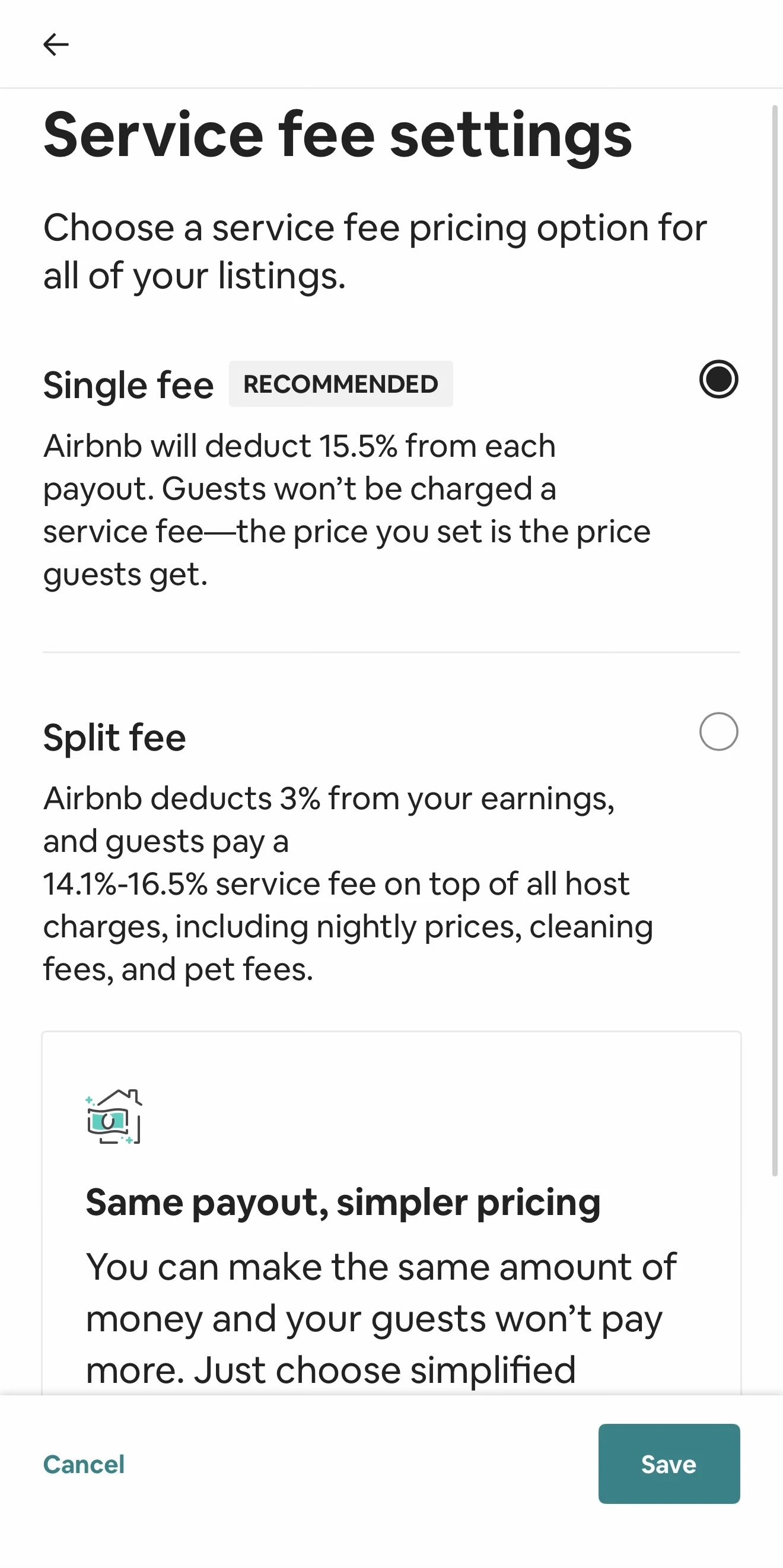
I'm including a screenshot from my Airbnb app showing the opt-back option as it currently appears in settings — for anyone who hasn't navigated there yet and wants to see what we're talking about.
I don't have clean answers to most of these questions. But the hosts in this community have the most sophisticated operational read on what's actually happening — and comparing notes seems considerably more useful right now than waiting for Airbnb to tell us.