



how to address limits on air conditioning

  • October 15, 2025
  • 5 replies
  • 72 views

madams
New Participant
Forum|alt.badge.img

We’ve gotten dinged lately on our air conditioning limits.  We allow guests to adjust the thermostat within the range 72°-80°.  Most of the time, since we’re in MS, it’s in cooling mode.  Some guests, if allowed, would and have set the thermostat down into the 60s, and neither of the two units would ever cool to those temperatures.  So, we include the following everywhere we can in the listing:

Because the air conditioning units are residential and not commercial, we protect them by limiting the minimum cooling temperature.  Past guests have set the temperature far below generally accepted norms, well below 70º.  The units would never achieve those temperatures in the Mississippi heat and they've frozen up, resulting in no further air conditioning for days and costly repairs.  Thanks for understanding.  If you prefer inside temperatures lower than this, please do not book with us.


What else can we do to protect our A/C units?  They’ve frozen up before, which renders them inoperable for days, the guest has to leave, we have to give a refund, and then we have to have them serviced, which obviously costs, and if a leak is discovered, costs even more.

Any advice is appreciated.

5 replies

Kristijan Laco
Hospitable Team Member
Forum|alt.badge.img+2
  • Hospitable Team Member
  • October 15, 2025

Hi ​@madams ,


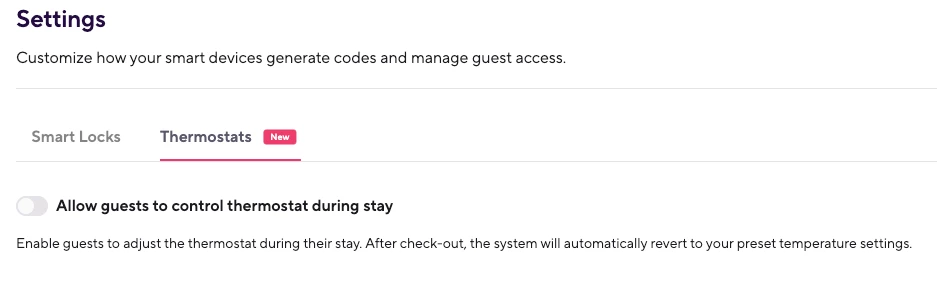
There’s a Hospitable thermostat setting that can help prevent this issue. You can choose not to allow guests to control the thermostat during their stay, which means the temperature will automatically revert to your defined occupied preset whenever it’s changed.


anthonyrallo
Known Participant
Forum|alt.badge.img+1
  • Known Participant
  • October 21, 2025

We’ve gotten dinged lately on our air conditioning limits.  We allow guests to adjust the thermostat within the range 72°-80°.  Most of the time, since we’re in MS, it’s in cooling mode.  Some guests, if allowed, would and have set the thermostat down into the 60s, and neither of the two units would ever cool to those temperatures.  So, we include the following everywhere we can in the listing:

Because the air conditioning units are residential and not commercial, we protect them by limiting the minimum cooling temperature.  Past guests have set the temperature far below generally accepted norms, well below 70º.  The units would never achieve those temperatures in the Mississippi heat and they've frozen up, resulting in no further air conditioning for days and costly repairs.  Thanks for understanding.  If you prefer inside temperatures lower than this, please do not book with us.


What else can we do to protect our A/C units?  They’ve frozen up before, which renders them inoperable for days, the guest has to leave, we have to give a refund, and then we have to have them serviced, which obviously costs, and if a leak is discovered, costs even more.

Any advice is appreciated.

It’s a real problem. We include similar info in our guide and some limits like you’ve placed on the therms are a good start. 


As ​@Kristijan Laco pointed out the integration with a few thermostats via HSPTB can make things simplified too. 


A tip I learned from an HVAC pro was if the line freezes up, turn it to HEAT (above the normal) for 45-60 mins and then back to cool. This will thaw the line and should get the cooling to begin again. 

Last resort might be a label on the thermostat with a warning that it will freeze up and stop working. 


Also, perhaps recalibrate the thermostat so it appears to be lower (but the actual temp is higher). This was you can let the thermostat go down to what seems unreasonable degrees and guest feels more in control (like close elevator door buttons). ​​​​​


ShaneStephens
Participating Frequently
Forum|alt.badge.img
  • Participating Frequently
  • October 28, 2025

I use a Honeywell T9 thermostat, this allows me to connect it to Hospitable and set some guidelines like you have above.  But it also allows me to set upper and lower limits, similar to a hotel thermostat.  The guest cannot move it below 69 or above 75.  It works for my climate in the Smokey Mountains.


Eli Stoughton
Participating Frequently
Forum|alt.badge.img+3
  • Participating Frequently
  • October 29, 2025

Considering that the most optimal temperature to sleep at is 65°F, I am not surprised that some guests find your restrictions to be troubling. I would certainly feel the same way. I think the Hospitable Thermostats feature is great for you. I don’t see how an AC would freeze up at 65°F but I guess there are all different kinds of AC out there.


anthonyrallo
Known Participant
Forum|alt.badge.img+1
  • Known Participant
  • October 30, 2025

Considering that the most optimal temperature to sleep at is 65°F, I am not surprised that some guests find your restrictions to be troubling. I would certainly feel the same way. I think the Hospitable Thermostats feature is great for you. I don’t see how an AC would freeze up at 65°F but I guess there are all different kinds of AC out there.

@Eli Stoughton I love to sleep cold too, but it is true (like ​@ShaneStephens notes) some systems struggle below a certain threshold based on insulation, direction facing the sun, cathedral ceilings etc. We had several issues this year with our HVAC in the Smokies - despite having a new unit installed just 1 year ago.